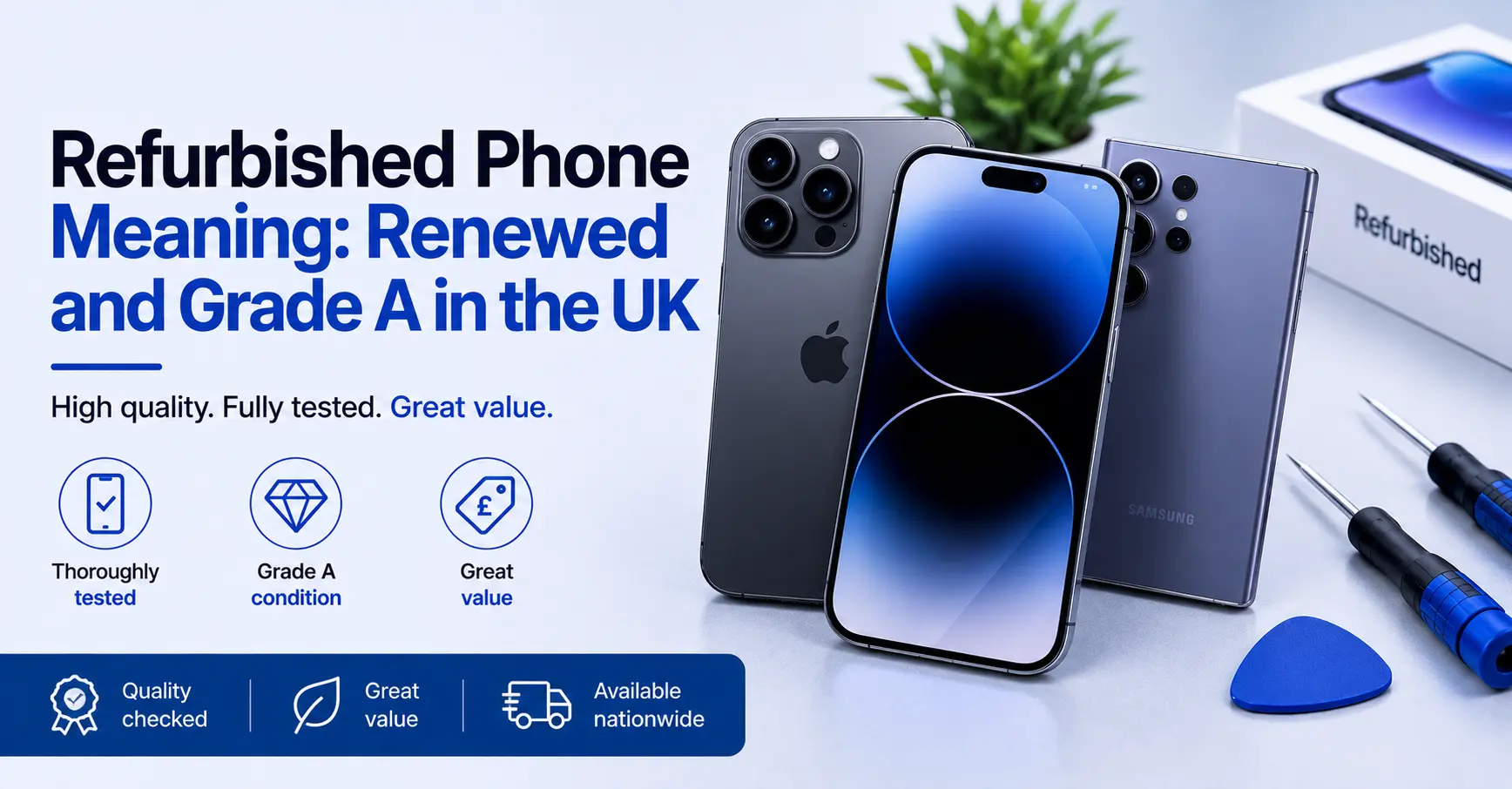
Refurbished Phone Meaning: Renewed and Grade A in the UK
If you have ever shopped for a second-hand smartphone, you have likely been confronted with a bewildering array of labels. Between “renewed,” “Grade A,” and “refurbished,” it is easy to feel like you need a decoder ring just to make a safe purchase. The problem is that in the UK, the term “refurbished” has no legal definition we are aware of. This means a phone described as refurbished could be anything from a meticulously restored device with new parts to a wiped-and-resold return that was simply checked for basic functionality.
Understanding the refurbished phone meaning is essential if you want to avoid paying over the odds for a device that has not been properly restored. This tutorial will cut through the marketing jargon. We will start with a short, clear definition before examining why the UK lacks a legal standard for the term. You will learn exactly what “renewed” implies on a product page and how the Grade A, B, and C scales actually work. We will also provide a side-by-side comparison of these terms and reveal the four critical questions you must ask to verify a phone’s history. Finally, we will look at how to spot a wiped-and-resold return before you pay and what to check before adding any handset to your basket.
Refurbished Phone Meaning: The Short Answer
A refurbished phone is a used handset that has been inspected, repaired where needed, cleaned, tested and then resold, rather than simply traded in and passed straight on to the next buyer.
That is the plain definition, not a legal one. Because no published CMA or Trading Standards guidance we are aware of sets a minimum standard for the term, the label depends entirely on the seller.
Beginners should hold onto one distinction: ‘used’ and ‘second hand’ describe a handset’s history, while ‘refurbished’ claims something was done to it after that history. The difference is the work, not the age.
The four facts that matter far more than the label are covered in their own section below.
The vocabulary is inconsistent. GSMA research on refurbished phone labelling frames labelling as a consumer-trust issue. The same handset can be advertised as ‘refurbished’, ‘renewed’ or ‘Grade A’ by three different UK sellers, each meaning something different, which is why the term cannot be trusted on its own.
Why ‘Refurbished’ Has No Legal Definition in the UK
No statute we are aware of defines ‘refurbished’. No regulator and no industry body sets a minimum standard for using the word on a product page. Legally, it is a marketing claim, not a quality guarantee. “Renewed”, “Grade A” and similar terms sit in exactly the same unregulated space.
What the law does cover is the sale itself. Under the Consumer Rights Act 2015, goods sold to a consumer must be of satisfactory quality, fit for the purpose described, and match their description. A listing that overstates condition or conceals faults can breach the Act even though the word “refurbished” is undefined.
The Competition and Markets Authority tackles misleading commercial practices. Since April 2025, under the Digital Markets, Competition and Consumers Act, it can decide breaches itself and impose significant financial penalties.
Where standards exist, they are private. Manufacturer programmes, network and insurance supply channels, and independent repairers each write their own testing specifications. Two “refurbished” handsets can therefore be worlds apart.
Practical takeaway: nobody enforces a definition, so the detail on the listing is the only real evidence of what was done to the phone.
What ‘Refurbished’ Should Mean on a UK Product Page
A genuine refurbishment is a process, not a polish. A proper workshop runs the handset through full functional testing across screen, cameras, speakers, microphones, buttons, charging, Wi-Fi and cellular; diagnoses any faults; repairs or replaces the failed components; reinstalls the operating system or firmware; deep cleans the device; assesses cosmetics; and completes a final quality check before the listing goes live.
That process is what separates refurbishment from a data wipe. Erasing the previous owner’s details removes information, not faults. A wiped handset is only refurbished if testing and repair happened too. Sellers also use ‘reconditioned’ and ‘restored’ alongside ‘refurbished’, but these are simply synonyms carrying no more legal weight.
So the ‘refurbished phones meaning’ question has a hidden second half: was this device returned to full working order with replacement parts disclosed, or was it cleaned, photographed and relisted?
Apply one test. A genuine refurbisher can name the checks performed and the parts fitted. A relisting seller can only describe how the phone looks.
‘Renewed’: What UK Sellers Are Actually Telling You
Where ‘refurbished’ at least points to a process, ‘renewed’ is a retailer-friendly synonym with no agreed meaning at all. It can describe a handset that was fully tested, repaired and cleaned, or one that was simply wiped, given a quick polish and relisted. The word exists to sidestep the stigma of ‘used’ and to imply ‘as good as new’. That implication is precisely the problem: it sounds like a guarantee but verifies nothing.
What ‘renewed’ never tells you:
- Battery health, in numbers or otherwise.
- Whether the screen, battery or other parts are original or aftermarket.
- How long the warranty runs, what it excludes, and who honours it.
Watch for phrases like ‘renewed to like new condition’ or ‘renewed and fully tested’. These usually describe appearance or a seller’s internal checklist, not a published, independently verifiable standard.
Apply the same four questions covered later in this guide.
Grade A, Grade B and Grade C: How UK Grading Scales Work
Unlike “renewed”, grades answer a separate question: they describe appearance, not internals. Grade A usually means minimal signs of use, with light marks invisible while the screen is on. Grade B means visible scratches or scuffs. Grade C means obvious wear on a handset that still works.
A grade tells you nothing else. It says nothing about battery health, screen originality, water resistance or repair history, so a Grade A phone can still carry a replacement screen or a tired battery.
No publicly available UK regulator or standards-body grading scale was found for refurbished phones at the time of writing. A Grade A from one seller may match another’s Grade B, and invented tiers such as “Grade A+” or “pristine” are self-defined marketing labels. In practice a human inspects casing, screen and ports against an internal photo guide, so genuine photographs of the unit matter more than the letter.
Before buying, check three things: are the grade definitions written out on the page, are there real photos of the unit being sold, and does the returns policy cover cosmetic disagreement as well as faults? Hiding these details risks breaching rules on misleading omissions.
Refurbished vs Renewed vs Grade A: A Side-by-Side Comparison
| Term | Defined by | Covers | Omits | Check before paying |
|---|---|---|---|---|
| Refurbished | Seller or refurbisher | Testing, repair, cleaning, reset | Parts fitted, warranty, battery health | Who did the work, to what standard, with which parts, what guarantee |
| Renewed | The retailer | Full repair to a wipe and clean | Battery health, part origin, who honours warranty | The same four questions |
| Grade A | Seller’s internal guide | Minimal cosmetic wear | Battery health, screen origin, water resistance | Written definition, photos, returns policy |
| Grade B | Seller’s internal guide | Visible scratches or scuffs | Functional detail | As Grade A |
| Grade C | Seller’s internal guide | Obvious wear, working device | Functional detail | As Grade A |
| Manufacturer or authorised partner | Manufacturer programme | Documented testing, original parts | Grade, warranty, battery figure | Parts policy, warranty length, battery health |
| Independent repairer or reseller | The business | Varies enormously | Often undisclosed | The same four questions |
Refurbished versus renewed asks about process; Grade A versus Grade B asks about cosmetics. The two cannot be compared directly. No publicly available UK regulator or standards-body grading scale was found for refurbished phones at the time of writing, so this table reflects typical seller practice, not law: treat it as a checklist of questions. Many ‘phone refurbished’ listings hide the grade definition in a FAQ or footer. Read and screenshot it before ordering.
The Four Questions That Reveal Whether a Phone Was Really Refurbished
Four direct questions cut through the label confusion.
Question one: who refurbished it? A named in-house technical team with repair capability, a manufacturer or authorised refurbishment programme, or an unnamed third party that only erased data and repackaged the handset.
Question two: to what standard? Ask for the testing regime, the number of functional checkpoints, and whether cosmetic and functional testing are handled separately. Treat “insurance-grade” or “certified” as undefined until the seller explains exactly what they mean.
Question three: with which parts? Original manufacturer components, genuine parts pulled from donor devices, or aftermarket equivalents. Any screen or battery replacement should be disclosed in the listing, not discovered later.
Question four: what warranty and battery-health guarantee applies? Confirm the length and type of cover, whether it is a seller warranty or manufacturer warranty, what it excludes, and whether battery health is guaranteed to a stated figure or merely described as “good”.
Run the checks listed in the next section before paying.
How to Spot a Wiped-and-Resold Return Before You Pay
If those four questions go unanswered, you are probably looking at a wiped-and-resold return: a returned, traded-in or insurance-replacement handset that has had the previous owner’s data erased, a screen protector applied and a listing created. No repair. No component testing. No documented quality check.
The giveaways are consistent. The listing names no refurbishment process. It quotes no battery health figure. The warranty is very short, shorter than the statutory 30-day right to reject under the Consumer Rights Act 2015, or there is no warranty at all. Condition caveats sit buried in the description. Stock photography replaces images of the actual unit.
Battery health is the costliest omission. A handset whose battery health is not disclosed may need a replacement battery sooner than you expect, lowering the deal’s real value. Factor that cost in before comparing prices.
A wiped return is not automatically a bad purchase. It is simply a used handset and should be priced like one, not sold at a refurbishment premium for work nobody did.
The safest listing profile discloses grade, parts, warranty and battery health in writing before purchase, and offers a returns window long enough to test the handset at home.
Genuine Refurbishment in Practice: CrC Repair’s Handset Range
A handset sold by a repair-led operation looks different from one sold by a relister. CrC Repair, as the company presents itself, is a London-based repair and refurbishment operation trading since 2012, originally established as a Samsung Support Centre and now servicing mobiles, tablets, computers and wearables across major brands.
In consumer terms, its refurbishment work means handsets are functionally tested and repaired before resale, prepared to the standards insurance and trade supply channels expect as well as walk-in customers.
CrC describes its quality positioning as adhering to standards such as those set by insurance companies. That phrase is the company’s own description, not a published specification, so ask for the testing regime, grade criteria and parts policy in writing before you buy.
The Refurbished Handset range sells graded devices with condition and warranty disclosed; Trade-in and Trade-up offset a new purchase against your old handset. CrC is also a partner in Assurant PGUK’s Pocket Geek Tech Repair network, which, according to CrC Repair, Mobile News recognised as Best Service and Repair Provider 2023.
What to Do Before You Add a Refurbished Phone to Your Basket
With that groundwork in place, here is how to apply it at the point of purchase.
Three definitions, in one line each. Refurbished means tested, repaired and warrantied. Renewed is an undefined synonym that may mean either. Grade A describes cosmetics only and says nothing about what is inside.
Use the four questions and four checks from the sections above.
Buy only where grade, parts, warranty and battery health are disclosed in writing. Treat any listing that omits them as a used device at best, and pay a used price rather than a refurbishment premium.
Ready to buy? CrC Repair’s refurbished handset range and trade-in or trade-up service let UK buyers purchase with the refurbishment detail confirmed before money changes hands.
Conclusion
In the UK, ‘refurbished’ has no legal definition we are aware of. Ready to choose a phone that meets that standard? Explore CrC Repair’s refurbished handset range and trade-in or trade-up service. Confirm the refurbishment detail before you pay, then enjoy a better device for less.